


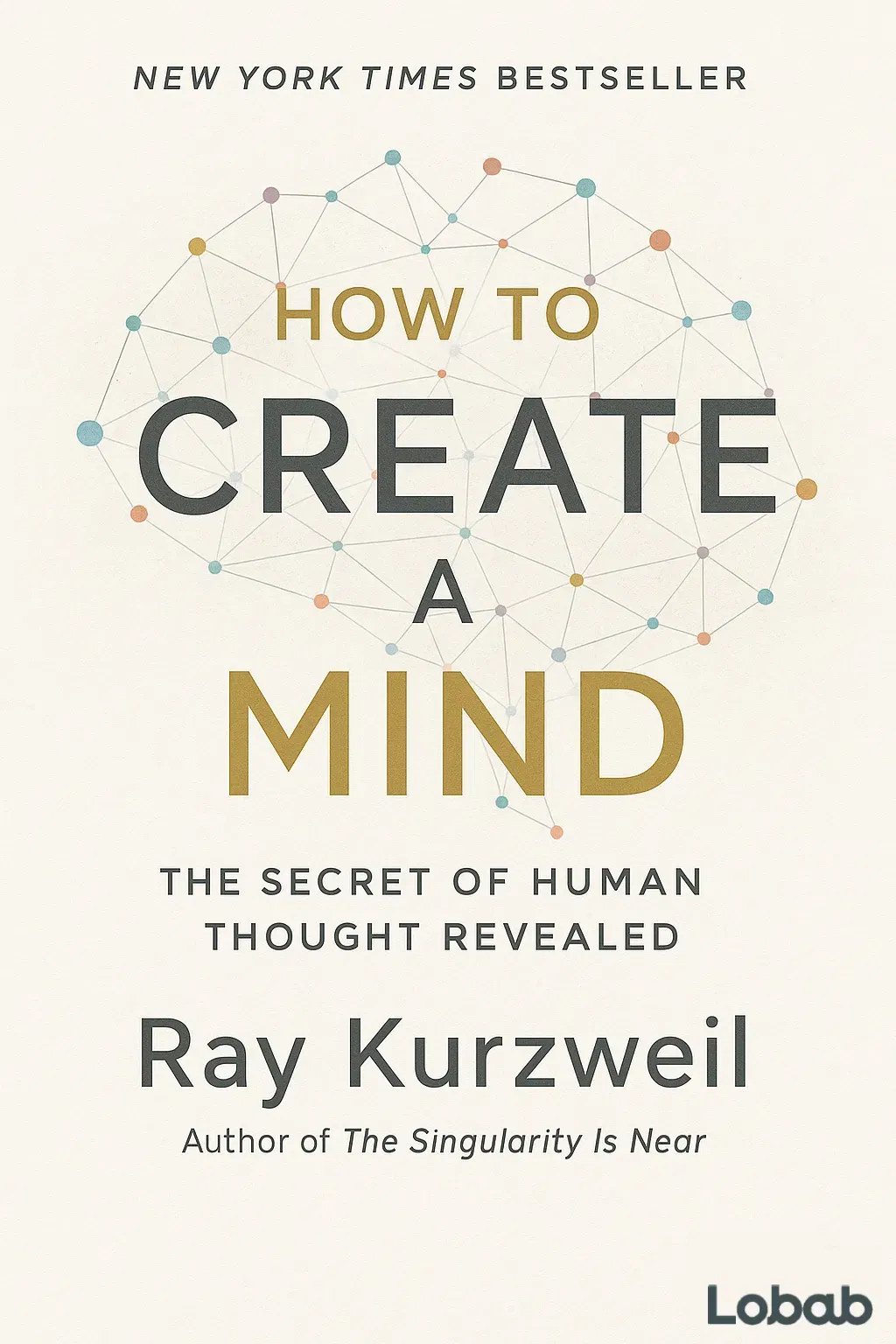
How to Create a Mind
By Ray Kurzweil
The Secret of Human Thought Revealed. Viking Press, 2012.
Summary of How to Create a Mind book by Ray Kurzweil
A concise, research-based text that explores how the brain develops, works, and continues to evolve, advancing new theories regarding artificial intelligence, including its growing connection to the human mind.
Chapters in How to Create a Mind book summary
What do you get from this book? How the human brain and artificial intelligence are uniquely connected
“Thought experiments” helped Darwin and Einstein develop their groundbreaking theories on natural selection and lightspeed travel
The neocortex influences our perception of things, fills in gaps, and helps us recognize patterns
PRTM has three steps that help us identify patterns, allowing our brains to send out appropriate signals
Patterns are two-dimensional, but our brains utilize one-dimensional links to help us learn and retain memories
Neurons are connected by a “Lego-like” structure made up of a shared algorithm that drives intelligence
There are several parts of the brain that work together to simplify behaviors, enhance pleasure, and create fear
Spindle neurons are responsible for creativity, love, and higher-level emotions
Creating a digital brain simulation is vital to further our understanding of the neocortex and expand human knowledge
“Perceptrons” and the “Hidden Markov Model” are the basis for voice recognition software
LISP And CycL Programs attempted to set parameters for AI programs, while new software has led to fascinating advancements
Consciousness, communication, and subjective beliefs are the core debates of modern-day scientists and philosophers
The Law of Accelerating Returns is based on the evolving nature of things, though some opponents criticize the theory
Summary of the key insights
Selected critiques in brief
Final word
Unlock all 16 chapters of How to Create a Mind — Get full access to this book summary and thousands more on Lobab.
How to Create a Mind — Book Summary Snapshot
Who should read How to Create a Mind book
- Evolutionary theorists
- medical professionals
- psychologists
- anyone interested in the human brain or technology
About the author of How to Create a Mind

Ray Kurzweil
Inventor Ray Kurzweil is regarded for his futurist theories on technological subjects such as speech recognition, artificial intelligence, and life extension. In 1999, he received the National Medal of Technology and Innovation, and in 2002, he was inaugurated into the National Inventors Hall of Fame. PBS has named him one of the “sixteen revolutionaries who made America.”
Books similar to How to Create a Mind
Related books that explore themes found in How to Create a Mind
Will Storr
Why Stories Make Us Human and How to Tell Them Better. Collins, 2019.
Kayt Sukel
The Science Behind the Search for Love. Simon & Schuster, 2013. Previously published as Dirty Minds: How Our Brains Influence Love, Sex, and Relationships.
Tom Griffiths
The Computer Science of Human Decisions. Henry Holt, 2016.
Lisa Feldman Barrett
The Secret Life of the Brain. Houghton Mifflin Harcourt, 2017.
Benedict Carey
The Surprising Truth About When, Where, and Why It Happens. Random House, 2014.
Barbara Oakley
How to Excel at Math and Science (Even If You Flunked Algebra). The Penguin Group, 2014 .
Loretta Graziano
Dopamine, Endorphin, Oxytocin, Serotonin. Createspace, 2012.
Sharon Moalem
How Our Genes Change Our Lives, and Our Lives Change Our Genes. Sceptre, 2015.
Topics related to How to Create a Mind book
Explore topics that share themes with How to Create a Mind across Lobab's library


Categories How to Create a Mind book belongs to
Discover other book summaries in the same categories as How to Create a Mind
If you liked How to Create a Mind, you might also enjoy
Books on different topics that Lobab readers often explore alongside How to Create a Mind
David A. Sinclair
Why We Age and Why We Don’t Have To. Atria Books, 2019.
Rodrigo Quian Quiroga
Memory, Perception and the “Jennifer Aniston Neuron.” BenBella Books, 2017.
Nancy C. Andreasen
The Science of Genius. Plume, 2006.
Carl Zimmer
The Powers, Perversions, and Potential of Heredity. Dutton, 2018.
Christina Thompson
The Puzzle of Polynesia. HarperCollins, 2019.
David Leavitt
Alan Turing and the Invention of the Computer. Atlas Books, 2006.
Stuart Firestein
How It Drives Science. Oxford University Press, 2012.
James Lovelock
The Coming Age of Hyperintelligence. The MIT Press, 2019.
Ainissa Ramirez
How Humans and Matter Transformed One Another. MIT Press, 2020.
Nate Pedersen
A Brief History of the Worst Ways to Cure Everything. Workman Publishing, 2017.
Can't decide where to start?
With thousands of book summaries across multiple categories and topics, there's always something new to discover. Browse the full library to find your next great read.
Your library
All-you-can-read
Categories
15 categories
Topics
120+ topics
Today's free book summary
Every day, one book summary is completely free to read. Subscribe to unlock the entire library — or just enjoy today's pick on us.
A Brief History of Everyone Who Ever Lived
Adam Rutherford
The eye-opening and sometimes controversial tale of humanity that interweaves a geneticist’s hard data with stories from history, asking questions we’re still learning the answers to while transforming the way we think about evolution.
Library
All-you-can-read
Formats
Text & audio
Free daily
1 book / day
What Lobab readers are saying
Not sure if Lobab book summaries are for you? Here's what our community thinks.
“Lobab is a standout in the world of book summary apps, offering concise, insightful summaries of a wide range of books. Its user-friendly interface and well-crafted summaries allow users to quickly grasp the essence of complex works, making it an invaluable tool for those looking to learn more in less time. Whether for personal growth or professional development, Lobab is a game changer for anyone wanting to expand their knowledge efficiently. Highly recommended!”
Ramogh
Lobab Reader
“Top quality app with plenty of brilliant summaries!”
Benjamin Roche
Lobab Reader
“I found a really great book app that has made reading even more enjoyable ⭐️📚. It is super easy to use, has a lot of books to choose from, gives personalized recommendations, works well with e-readers, has an active community, and is accessible to everyone. I highly recommend it to all book enthusiasts!”
Nedal Ahmed
Lobab Reader