


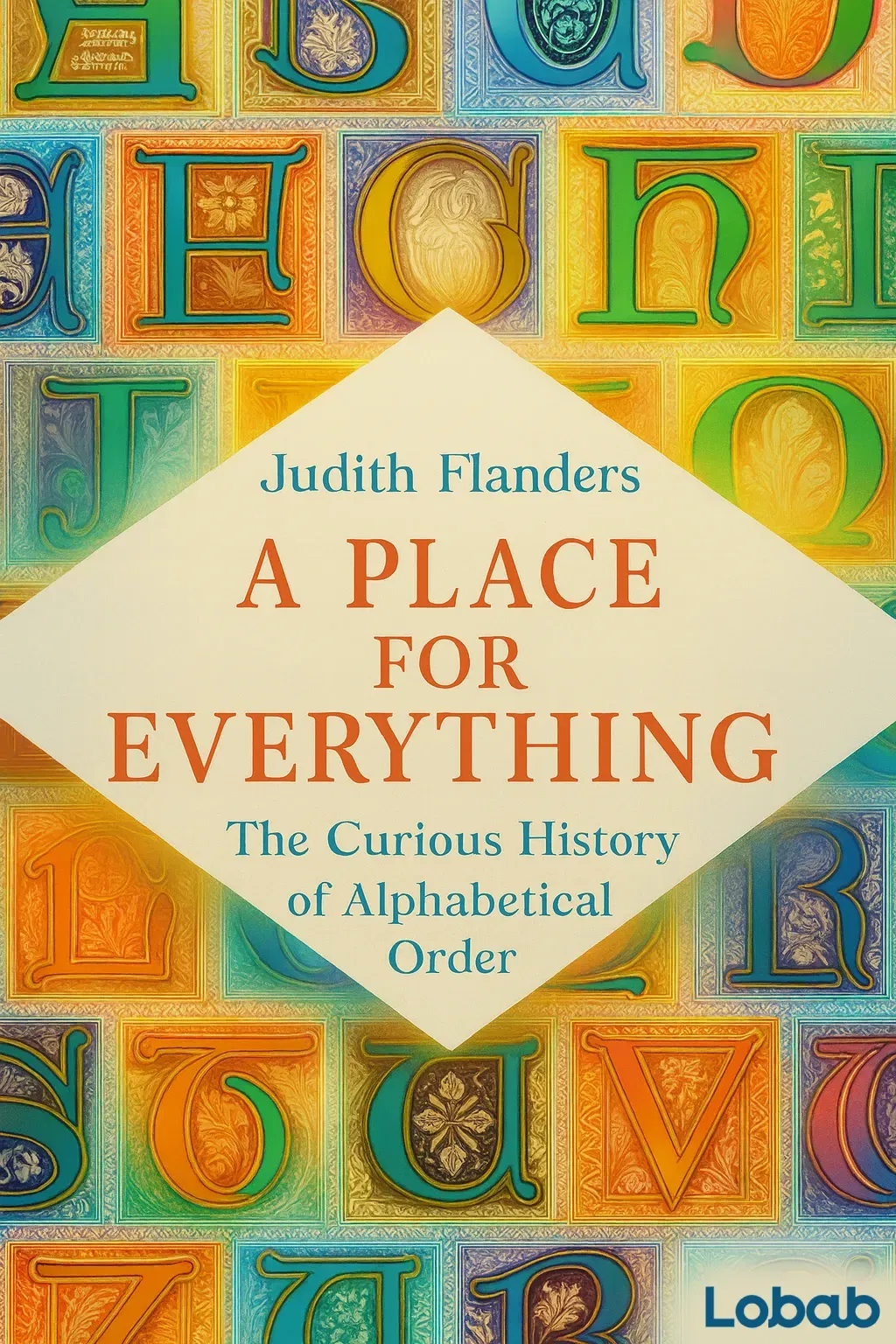
A Place for Everything
By Judith Flanders
A Curious History of Alphabetical Order. Basic Books, 2020.
Summary of A Place for Everything book by Judith Flanders
The fascinating tale of how alphabetical order came to dominate modern arrangements of information—whether it’s in books, libraries, or filing cabinets—and an account of why it may not be as intuitive as it seems to some today.
Chapters in A Place for Everything book summary
What do you get from this book? An exploration of how alphabetization became a cornerstone of modern information society
Written language enabled expanding societies, but most ancient civilizations didn’t recognize their alphabets’ sorting potential
Early alphabetical innovators—like Isidore of Seville—couldn’t break the hold of hierarchical ordering in priests’ libraries
The appearance of paper presented early medieval societies with new organizational demands, while universities needed more efficient research methods
From Amsterdam to Zurich, indexing helped Europe pave a path towards the intellectual explosion of the Renaissance
Printing took books to the people, while fashionable new herbal texts popularized alphabetical ordering
Lawyers and governments increasingly turned to alphabetization to tame the wild rise in documentation of the seventeenth century
While growing trade soon demanded novel ways of organizing information, scientists were testing methods to organize their data
Alphabetization earned new philosophical supporters—though some poets and thinkers complained, accusing it of “randomness”
Alphabetization helped build the modern office, where the newly-invented filing cabinet revolutionized workers’ access to information
Twentieth-century tech from the phone to the Internet has been enabled—and limited—by the Western reliance on alphabetical order
Summary of the key insights
Selected critiques in brief
Final word
Unlock all 14 chapters of A Place for Everything — Get full access to this book summary and thousands more on Lobab.
A Place for Everything — Book Summary Snapshot
Who should read A Place for Everything book
- Literature lovers
- fans of an unusual tale
- history enthusiasts
- those who long for a perfectly put-together bookshelf
About the author of A Place for Everything

Judith Flanders
Judith Flanders is a historian and journalist specializing in the history of the Victorian period. She has written for The Guardian, The Spectator, and The Times Literary Supplement. She was a historian and advisor in the production of video game Assassin’s Creed Syndicate, and her other publications include A Circle of Sisters (2001) and The Making of Home (2014).
Books similar to A Place for Everything
Related books that explore themes found in A Place for Everything
Simon Sebag Montefiore
Letters that Changed the World. Weidenfeld & Nicolson, 2018.
Emily Prokop
The Extraordinary History of Ordinary Objects. Mango Publishing Group, 2018.
David Rooney
A History of Civilization in Twelve Clocks. W. W. Norton & Company. 2021.
Thomas C. Foster
A Lively and Entertaining Guide to Reading Between the Lines, Revised Edition. Harper Perennial, 2014.
Marcel Proust
Days of Reading. Penguin Books’ edition, 2008
Topics related to A Place for Everything book
Explore topics that share themes with A Place for Everything across Lobab's library


Categories A Place for Everything book belongs to
Discover other book summaries in the same categories as A Place for Everything
If you liked A Place for Everything, you might also enjoy
Books on different topics that Lobab readers often explore alongside A Place for Everything
Christina Thompson
The Puzzle of Polynesia. HarperCollins, 2019.
Kassia St. Clair
The Secret Lives of Color. Penguin Books, 2017.
Stephen Greenblatt
How Shakespeare Became Shakespeare. W.W. Norton & Company, 2016.
Mark Miodownik
Exploring the Marvelous Materials that Shape Our Man-Made World. Mariner Books, 2015.
Nate Pedersen
A Brief History of the Worst Ways to Cure Everything. Workman Publishing, 2017.
Gareth Murphy
The Epic History of the Record Industry. Thomas Dunne Books, 2014.
Thomas C. Foster
A Lively and Entertaining Guide to Reading Between the Lines, Revised Edition. Harper Perennial, 2014.
Guy Deutscher
Why the World Looks Different in Other Languages. Picador, 2011.
Adam Higginbotham
The Untold Story of the World’s Greatest Nuclear Disaster. Transworld Digital, 2019.
Can't decide where to start?
With thousands of book summaries across multiple categories and topics, there's always something new to discover. Browse the full library to find your next great read.
Your library
All-you-can-read
Categories
15 categories
Topics
120+ topics
Today's free book summary
Every day, one book summary is completely free to read. Subscribe to unlock the entire library — or just enjoy today's pick on us.
A Brief History of Everyone Who Ever Lived
Adam Rutherford
The eye-opening and sometimes controversial tale of humanity that interweaves a geneticist’s hard data with stories from history, asking questions we’re still learning the answers to while transforming the way we think about evolution.
Library
All-you-can-read
Formats
Text & audio
Free daily
1 book / day
What Lobab readers are saying
Not sure if Lobab book summaries are for you? Here's what our community thinks.
“Lobab is a standout in the world of book summary apps, offering concise, insightful summaries of a wide range of books. Its user-friendly interface and well-crafted summaries allow users to quickly grasp the essence of complex works, making it an invaluable tool for those looking to learn more in less time. Whether for personal growth or professional development, Lobab is a game changer for anyone wanting to expand their knowledge efficiently. Highly recommended!”
Ramogh
Lobab Reader
“Top quality app with plenty of brilliant summaries!”
Benjamin Roche
Lobab Reader
“I found a really great book app that has made reading even more enjoyable ⭐️📚. It is super easy to use, has a lot of books to choose from, gives personalized recommendations, works well with e-readers, has an active community, and is accessible to everyone. I highly recommend it to all book enthusiasts!”
Nedal Ahmed
Lobab Reader