


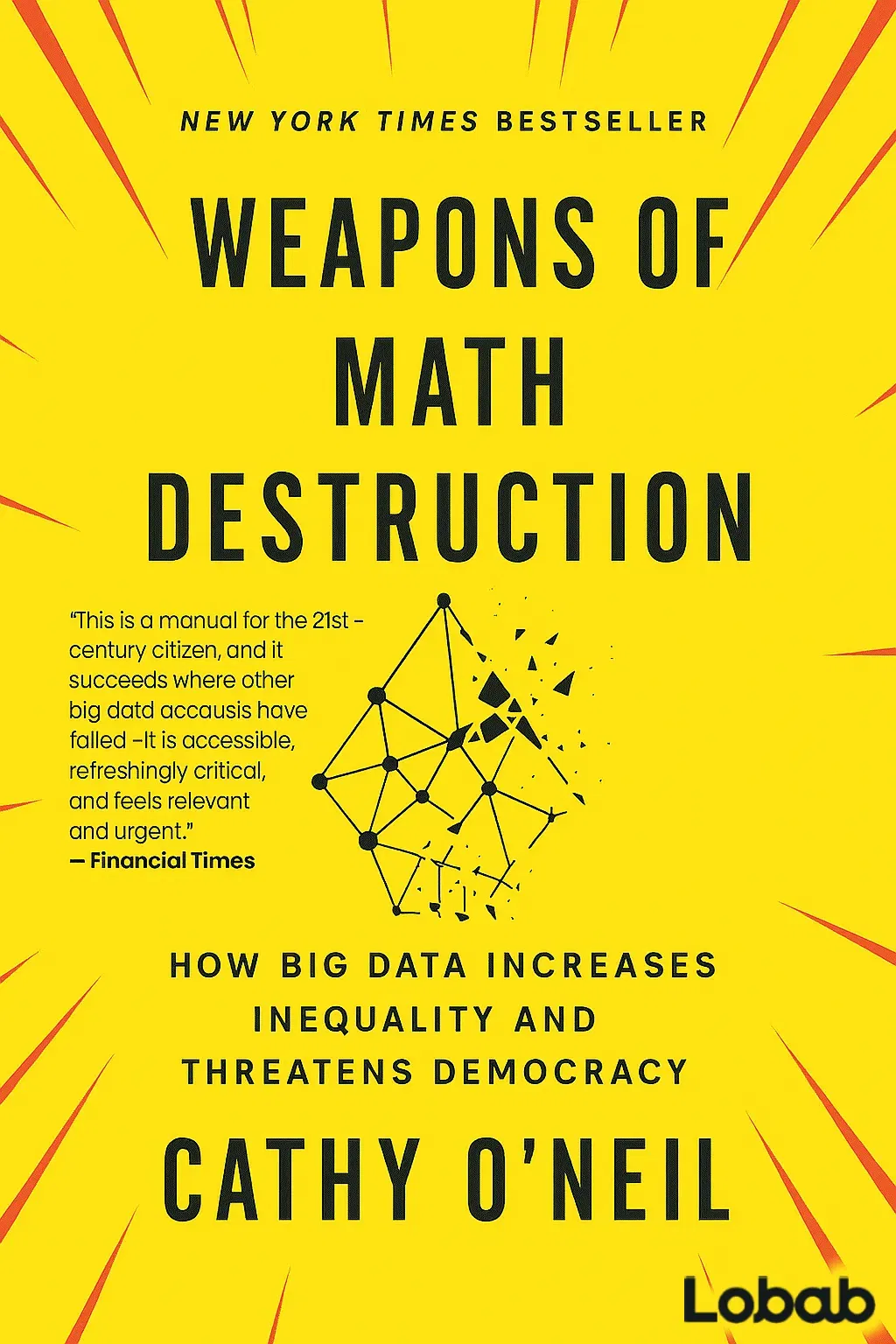
Weapons of Math Destruction
By Cathy O'Neil
How Big Data Increases Inequality and Threatens Democracy. Crown, 2016.
Summary of Weapons of Math Destruction book by Cathy O'Neil
An eye-opening discussion of the algorithms and models that put Big Data to work in our lives, affecting us in increasingly significant ways and leading to disturbing outcomes, as we’re transformed into the numbers that feed these powerful mathematical weapons.
Chapters in Weapons of Math Destruction book summary
What do you get from this book? A compelling argument exposing the dangerous misuse of mathematical models and Big Data
O’Neil experienced the dark side of statistical models while working on Wall Street, then saw the rise of Big Data
WMDs create devastating feedback loops and are always opaque, damaging, and exponentially expand their scale
Models are simplified representations of processes; decisions always need to be made about what to include and what to ignore
American higher education has been corrupted by one powerful WMD since the 1980s: the U.S. News college rankings
Predatory advertising uses data scraped from people’s online activity to target the most vulnerable sectors of the population
Law enforcement and the criminal justice system rely on WMDs which lead to over-policing of impoverished communities
Large companies often use standardized personality tests and automatic résumé readers when deciding who to hire
Scheduling software locks low-wage workers into a cycle of unpredictable, exhausting shifts—while optimizing profits for businesses
Automatic systems generate inaccurate, unregulated credit scores—which are used to judge people morally
The insurance industry uses surveillance and data to justify unequal prices, once again exploiting those who most need help
Facebook researchers have experimented with millions of users and influenced their behavior, while political microtargeting deepens divisions and undermines democracy
There are ways to disarm WMDs, but they require us to work together and demand regulations and transparency
Summary of the key insights
Selected critiques in brief
Final word
Unlock all 16 chapters of Weapons of Math Destruction — Get full access to this book summary and thousands more on Lobab.
Weapons of Math Destruction — Book Summary Snapshot
Who should read Weapons of Math Destruction book
- Math and statistics students
- data analysts
- people fascinated by Big Data
- people worried about information privacy
- anyone interested in the social impacts of technology
About the author of Weapons of Math Destruction

Cathy O'Neil
Cathy O’Neil, PhD, is a mathematician who was a professor at Columbia University before working at a leading hedge fund on Wall Street. She then transitioned to data science and subsequently into her role as an author and educator, promoting the importance of human-centered approaches in computing and data practices.
Books similar to Weapons of Math Destruction
Related books that explore themes found in Weapons of Math Destruction
Amy Chua
Group Instinct and the Fate of Nations. Penguin Books, 2018.
Margaret O'Mara
Silicon Valley and the Remaking of America. Penguin Press, 2019.
Vivek Wadhwa & Farai Chid
The Changing Face of Technology. Diversion Books, 2014.
Ian Stewart
17 Equations That Changed the World. Basic Books, 2012.
Topics related to Weapons of Math Destruction book
Explore topics that share themes with Weapons of Math Destruction across Lobab's library


Categories Weapons of Math Destruction book belongs to
Discover other book summaries in the same categories as Weapons of Math Destruction
If you liked Weapons of Math Destruction, you might also enjoy
Books on different topics that Lobab readers often explore alongside Weapons of Math Destruction
Cecilia Kang
Inside Facebook’s Battle for Domination. Harper. 2021.
Daron Acemoglu
The Origins of Power, Prosperity, and Poverty. Currency, 2012.
Kurt Andersen
The Unmaking of America – A Recent History. Ebury Press, 2020.
Aaron Bobrow-Strain
A Border Story. Farrar, Straus and Giroux, 2019.
Alex J. Gutman
How to Think, Speak, and Understand Data Science, Statistics, and Machine Learning. Wiley, 2021.
Thomas C. Foster
A Smart, Irreverent Guide to Biography, History, Journalism, Blogs, and Everything in Between. Harper Perennial, 2020.
Charles Fishman
The American Dream and the Untold Story of the Black Women Mathematicians Who Helped Win the Space Race. William Morrow, 2016.
Eliot Higgins
Global Crime, Online Sleuths and the Bold Future of News. Bloomsbury Publishing, 2021
Max Fisher
The Inside Story of How Social Media Rewired Our Minds and Our World. Little, Brown and Company, 2022.
Jasmine Brown
The Stories of Black Women Who Fought to Become Physicians, from the Civil War to the 21st Century. Beacon Press, 2023.
Can't decide where to start?
With thousands of book summaries across multiple categories and topics, there's always something new to discover. Browse the full library to find your next great read.
Your library
All-you-can-read
Categories
15 categories
Topics
120+ topics
Today's free book summary
Every day, one book summary is completely free to read. Subscribe to unlock the entire library — or just enjoy today's pick on us.
How to Have a Good Day
Caroline Webb
Pragmatic advice on how to make your work and life more fulfilling, productive, and energizing by using techniques drawn from advances in behavioral economics, positive psychology, and neuroscience.
Library
All-you-can-read
Formats
Text & audio
Free daily
1 book / day
What Lobab readers are saying
Not sure if Lobab book summaries are for you? Here's what our community thinks.
“Lobab is a standout in the world of book summary apps, offering concise, insightful summaries of a wide range of books. Its user-friendly interface and well-crafted summaries allow users to quickly grasp the essence of complex works, making it an invaluable tool for those looking to learn more in less time. Whether for personal growth or professional development, Lobab is a game changer for anyone wanting to expand their knowledge efficiently. Highly recommended!”
Ramogh
Lobab Reader
“Top quality app with plenty of brilliant summaries!”
Benjamin Roche
Lobab Reader
“I found a really great book app that has made reading even more enjoyable ⭐️📚. It is super easy to use, has a lot of books to choose from, gives personalized recommendations, works well with e-readers, has an active community, and is accessible to everyone. I highly recommend it to all book enthusiasts!”
Nedal Ahmed
Lobab Reader