


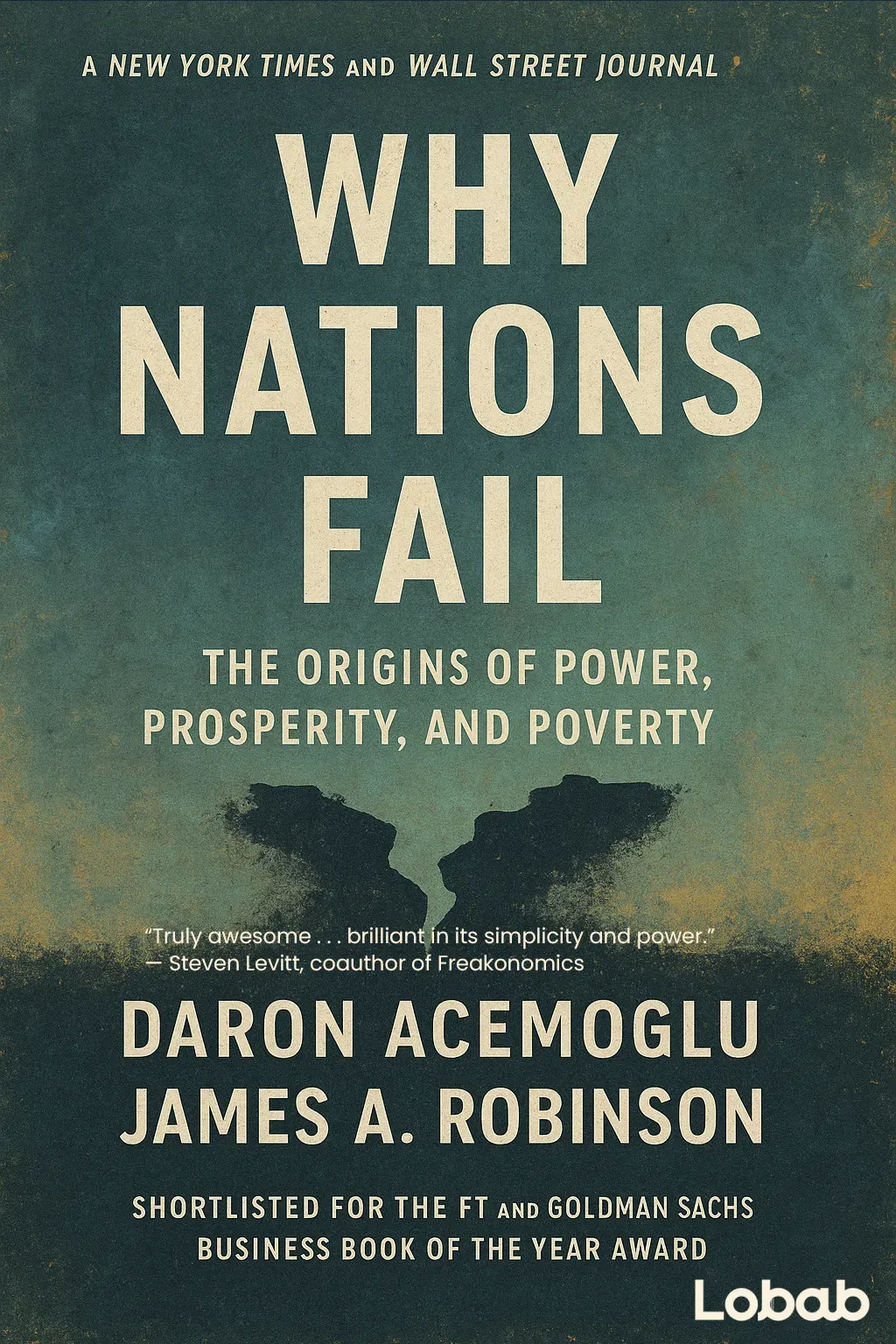
Why Nations Fail
By Daron Acemoglu & James A. Robinson
The Origins of Power, Prosperity, and Poverty. Currency, 2012.
Summary of Why Nations Fail book by Daron Acemoglu & James A. Robinson
A deep analysis of the differences between countries based on their political structure, from medieval Europe to modern Sierra Leone, explaining that civil society and rule by many sets the stage for economic success.
Chapters in Why Nations Fail book summary
What do you get from this book? An exploration of economic disparity across the globe
One city straddling two countries displays how citizens on each side have experienced very different economic outcomes
Early US colonists sowed the seeds for the development of the strong institutions that have enabled America’s success
A tale of two entrepreneurs demonstrates the advantages of American institutions to business
Quite a few of the existing explanations for economic disparity don’t ring true—one key factor defines global inequality
Critical moments in a nation’s history allow them chances to break free from oppressive and extractive governments that stifle growth
Venice and Rome thrived economically for a time—until extractive institutions concentrated power in the hands of a small elite
Creative destruction is crucial to healthy economies, but often sparks fear in the powerful
The effects of slavery on Africa were economically as well as socially catastrophic, limiting its nations’ ability to industrialize
Inclusive institutions grow stronger in a “virtuous circle” where increased participation incentivizes people to preserve them
The vicious cycle of extractive institutions means new rulers often retain the disastrous structures of deposed ones
Extractive and inclusive institutions do not explain everything—history is not predetermined, and human decisions make all the difference
Summary of the key insights
Selected critiques in brief
Final word
Unlock all 15 chapters of Why Nations Fail — Get full access to this book summary and thousands more on Lobab.
Why Nations Fail — Book Summary Snapshot
Who should read Why Nations Fail book
- Politicians
- economics enthusiasts
- college students
- citizens of any country
- those who want to know why some nations are more economically stable than others
About the author of Why Nations Fail

Daron Acemoglu
Daron Acemoglu is a professor of economics at the Massachusetts Institute of Technology (MIT). According to Research Papers in Economics, he was the most cited economist for 2005–2015. Also a professor, James A. Robinson teaches global conflict studies at the University of Chicago and focuses his research on Latin America and Africa. The two have written several books together including Why Nations Fail and The Narrow Corridor.
Books similar to Why Nations Fail
Related books that explore themes found in Why Nations Fail
Mark Buchanan
What Physics, Meteorology, and the Natural Sciences Can Teach Us About Economics. Bloomsbury, 2013.
Peter Frankopan
A New History of the World. Bloomsbury Paperbacks, 2016.
Thomas E. Ricks
What America's Founders Learned from the Greeks and Romans and How That Shaped Our Country. Harper, 2020.
John David Turner
A Global History of Economic Bubbles. Cambridge University Press, 2020.
Raghuram Rajan
How Hidden Fractures Still Threaten the World Economy. Princeton University Press, 2010.
Henry Kissinger
Reflections on the Character of Nations and the Course of History. Penguin, 2015.
Topics related to Why Nations Fail book
Explore topics that share themes with Why Nations Fail across Lobab's library


Categories Why Nations Fail book belongs to
Discover other book summaries in the same categories as Why Nations Fail
If you liked Why Nations Fail, you might also enjoy
Books on different topics that Lobab readers often explore alongside Why Nations Fail
David Goldblatt
A Global History of the Olympics. W.W. Norton & Company, 2016.
David Rooney
A History of Civilization in Twelve Clocks. W. W. Norton & Company. 2021.
Anita Anand
A True Tale of Massacre, Revenge, and India's Quest for Independence. Scribner, 2019.
Mark Pendergrast
The History of Coffee and How It Transformed the World. Basic Books, 2019.
Robert Greene
The 48 Laws of Power. Penguin Books, 1998.
Toby Wilkinson
The Golden Age of Egyptology. W.W. Norton & Company, 2020.
Adam Higginbotham
The Untold Story of the World’s Greatest Nuclear Disaster. Transworld Digital, 2019.
Timothy C. Winegard
A Human History of Our Deadliest Predator. Dutton, 2019.
David Cordingly
The Romance and the Reality of Life Among the Pirates. Random House, 2006.
Rebecca Rupp
Curious (but True) Stories of Common Vegetables. Storey Publishing, 2011.
Can't decide where to start?
With thousands of book summaries across multiple categories and topics, there's always something new to discover. Browse the full library to find your next great read.
Your library
All-you-can-read
Categories
15 categories
Topics
120+ topics
Today's free book summary
Every day, one book summary is completely free to read. Subscribe to unlock the entire library — or just enjoy today's pick on us.
The Joy of Missing Out
Tanya Dalton
A guide to clarifying what is important to you, prioritizing your time, and simplifying your tasks, in order to overcome stress and boost productivity in your life.
Library
All-you-can-read
Formats
Text & audio
Free daily
1 book / day
What Lobab readers are saying
Not sure if Lobab book summaries are for you? Here's what our community thinks.
“Lobab is a standout in the world of book summary apps, offering concise, insightful summaries of a wide range of books. Its user-friendly interface and well-crafted summaries allow users to quickly grasp the essence of complex works, making it an invaluable tool for those looking to learn more in less time. Whether for personal growth or professional development, Lobab is a game changer for anyone wanting to expand their knowledge efficiently. Highly recommended!”
Ramogh
Lobab Reader
“Top quality app with plenty of brilliant summaries!”
Benjamin Roche
Lobab Reader
“I found a really great book app that has made reading even more enjoyable ⭐️📚. It is super easy to use, has a lot of books to choose from, gives personalized recommendations, works well with e-readers, has an active community, and is accessible to everyone. I highly recommend it to all book enthusiasts!”
Nedal Ahmed
Lobab Reader