


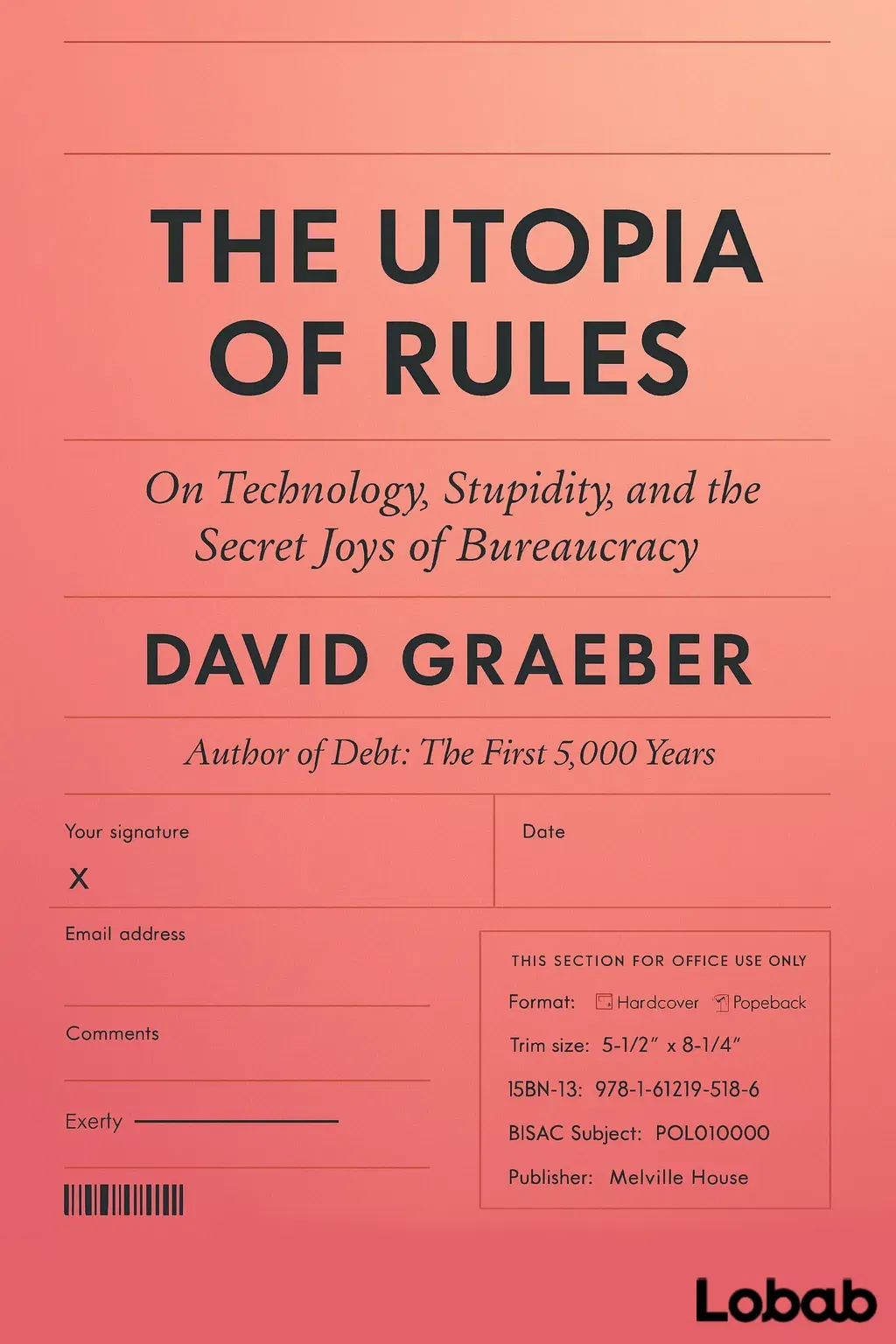
The Utopia of Rules
By David Graeber
On Technology, Stupidity, and the Secret Joys of Bureaucracy. Melville House, 2015.
Summary of The Utopia of Rules book by David Graeber
A brilliant analysis of how bureaucracy has invaded every aspect of people’s lives, especially those in the United States, and how this reflects the history and contemporary dynamics of politics, power, and the possibilities of a truly just and free world.
Chapters in The Utopia of Rules book summary
What do you get from this book? A penetrating look at the bureaucratic systems and political power that pervade contemporary life
Bureaucracy has seeped into all aspects of our lives, yet we don’t usually acknowledge its influence and power
The fusing of public and private—and increasing financialization—have brought corporate bureaucratic culture to all aspects of American society
In order to push back against the age of total bureaucratization, we need an effective critique of it
Bureaucratic systems are always tied to violence, which means that they involve an unavoidable stupidity
In highly unequal societies, the powerful make arbitrary decisions while the powerless are forced to engage in “interpretive labor”
Right-wing thought sees violence as the foundation of social life, while Left-wing thought proposes giving power to the imagination
Despite recent advances, technological development has not led to the “end of work,” as was predicted in the 20th century
Funding for technological advancement has stifled any potential for change, moving in the direction of surveillance and control instead
Even those sectors that have received lots of funding haven’t produced significant breakthroughs; corporate bureaucratic culture makes true innovation impossible
Although bureaucracy is oppressive and detrimental to human life, there is something subtly appealing about it
Fantasy stories and games demonstrate an anti-bureaucratic version of the world, but ultimately reinforce what we have now
Rules provide a sort of utopia by containing dangerous, freeform play and creating predictable, unambiguous games
Bureaucracies promise freedom, but it’s an illusion—the system we have only serves to extract wealth and crush us
Summary of the key insights
Selected critiques in brief
Final word
Unlock all 17 chapters of The Utopia of Rules — Get full access to this book summary and thousands more on Lobab.
The Utopia of Rules — Book Summary Snapshot
Who should read The Utopia of Rules book
- Political science students
- anthropologists and social theorists
- politics buffs
- people interested in Leftist thought
- anyone frustrated by bureaucracy
About the author of The Utopia of Rules

David Graeber
David Graeber (1961–2020) was a leading American anthropologist and activist known for his eminent contributions to the field of economic anthropology and incisive writing about politics. He was an active member of the Global Justice Movement in the 1990s, and later a leader during the Occupy Wall Street movement. Graeber passed away unexpectedly at the age of 59.
Books similar to The Utopia of Rules
Related books that explore themes found in The Utopia of Rules
Michiko Kakutani
Notes on Falsehood in an Age of Trump. Tim Duggan Books, 2018.
Ha-Joon Chang
Allen Lane, 2010.
Robert Reich
What Has Gone Wrong with Our Economy and Our Democracy, and How to Fix It. Alfred A. Knopf, 2012.
Topics related to The Utopia of Rules book
Explore topics that share themes with The Utopia of Rules across Lobab's library


Categories The Utopia of Rules book belongs to
Discover other book summaries in the same categories as The Utopia of Rules
If you liked The Utopia of Rules, you might also enjoy
Books on different topics that Lobab readers often explore alongside The Utopia of Rules
Daron Acemoglu
The Origins of Power, Prosperity, and Poverty. Currency, 2012.
Kurt Andersen
The Unmaking of America – A Recent History. Ebury Press, 2020.
Isabel Allende
On Impatient Love, Long Life, and Good Witches. Ballantine Books, 2021.
Anita Anand
A True Tale of Massacre, Revenge, and India's Quest for Independence. Scribner, 2019.
Max Fisher
The Inside Story of How Social Media Rewired Our Minds and Our World. Little, Brown and Company, 2022.
Robert Greene
The 48 Laws of Power. Penguin Books, 1998.
Adam Higginbotham
The Untold Story of the World’s Greatest Nuclear Disaster. Transworld Digital, 2019.
Mark Pendergrast
The History of Coffee and How It Transformed the World. Basic Books, 2019.
David Leavitt
Alan Turing and the Invention of the Computer. Atlas Books, 2006.
Can't decide where to start?
With thousands of book summaries across multiple categories and topics, there's always something new to discover. Browse the full library to find your next great read.
Your library
All-you-can-read
Categories
15 categories
Topics
120+ topics
Today's free book summary
Every day, one book summary is completely free to read. Subscribe to unlock the entire library — or just enjoy today's pick on us.
A Brief History of Everyone Who Ever Lived
Adam Rutherford
The eye-opening and sometimes controversial tale of humanity that interweaves a geneticist’s hard data with stories from history, asking questions we’re still learning the answers to while transforming the way we think about evolution.
Library
All-you-can-read
Formats
Text & audio
Free daily
1 book / day
What Lobab readers are saying
Not sure if Lobab book summaries are for you? Here's what our community thinks.
“Lobab is a standout in the world of book summary apps, offering concise, insightful summaries of a wide range of books. Its user-friendly interface and well-crafted summaries allow users to quickly grasp the essence of complex works, making it an invaluable tool for those looking to learn more in less time. Whether for personal growth or professional development, Lobab is a game changer for anyone wanting to expand their knowledge efficiently. Highly recommended!”
Ramogh
Lobab Reader
“Top quality app with plenty of brilliant summaries!”
Benjamin Roche
Lobab Reader
“I found a really great book app that has made reading even more enjoyable ⭐️📚. It is super easy to use, has a lot of books to choose from, gives personalized recommendations, works well with e-readers, has an active community, and is accessible to everyone. I highly recommend it to all book enthusiasts!”
Nedal Ahmed
Lobab Reader