


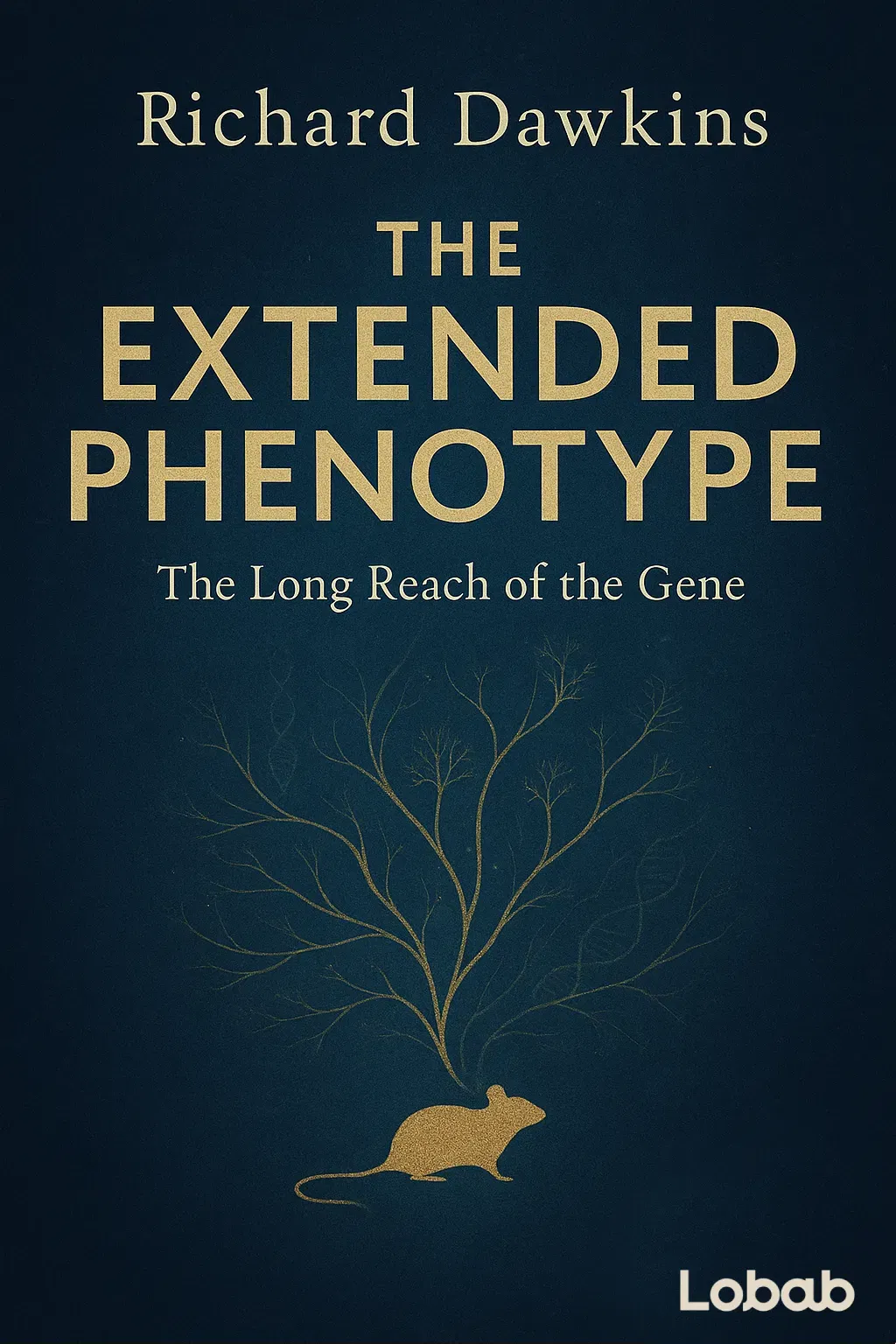
The Extended Phenotype
By Richard Dawkins
The Long Reach of the Gene. Oxford University Press, 1982.
Summary of The Extended Phenotype book by Richard Dawkins
A proposal for a new view of evolution that puts genes instead of individual organisms at the center of evolutionary change, shakes up orthodox views about natural selection, and questions our fundamental understanding of why the natural world looks the way it does.
Chapters in The Extended Phenotype book summary
What do you get from this book? A mind-bending argument about the central role of genes in evolution
Evolutionary biology has focused on the individual organism since Darwin, but genes are an alternative site of natural selection
Genetic determinism is a detrimental misunderstanding of Dawkins’ gene-centered evolutionary argument
There’s no such thing as perfect—evolution has no end goal and adaptations aren’t always entirely beneficial
The Darwinian concept of “fitness” is confusing and overly-complicated, but this is cleared up by shifting focus toward genes
Replicators are the fundamental unit of natural selection, and we should revise our definition of evolution to reference them
Even though asexual reproduction looks like the work of replicators, organisms are just vehicles that carry genetic replicators
Outlaw genes work against the good of the rest of the organism, but modifiers fight back
“Survival of the fittest” is no longer an adequate explanation; the selfish individual idea doesn’t account for complex adaptations
It’s more useful to think about selfish DNA—like surplus DNA and the “jumping genes” which mix up the genome
Beaver dams are a fascinating example of the way genetic replicators shape the world through extended phenotypes
Extended phenotypes can be shared across species, like parasites which affect the phenotypes of their hosts
Genetic replicators benefit from the ability of organisms to cyclically reproduce, as each new generation is able to develop differently
Summary of the key insights
Selected critiques in brief
Final word
Unlock all 16 chapters of The Extended Phenotype — Get full access to this book summary and thousands more on Lobab.
The Extended Phenotype — Book Summary Snapshot
Who should read The Extended Phenotype book
- Biologist and geneticists
- students studying the natural sciences
- anyone interested in evolution
- animal lovers
- scientific philosophers
About the author of The Extended Phenotype

Richard Dawkins
Richard Dawkins is an award-winning biologist whose profound ideas on genetic selection helped introduce a new field of evolutionary biology. He was the Professor for Public Understanding of Science at Oxford as well as a professor of zoology at UC Berkeley. Dawkins has published dozens of academic papers, articles, and books including The God Delusion and The Selfish Gene.
Books similar to The Extended Phenotype
Related books that explore themes found in The Extended Phenotype
Richard Dawkins
How We Know What’s Really True. Free Press, 2011.
Nick Lane
Mitochondria and the Meaning of Life. Oxford University Press, 2005.
Topics related to The Extended Phenotype book
Explore topics that share themes with The Extended Phenotype across Lobab's library


Categories The Extended Phenotype book belongs to
Discover other book summaries in the same categories as The Extended Phenotype
If you liked The Extended Phenotype, you might also enjoy
Books on different topics that Lobab readers often explore alongside The Extended Phenotype
Peter Wohlleben
Love, Grief, and Compassion ―Surprising Observations of a Hidden World. Greystone Books, 2016.
Sam Kean
And Other True Tales of Madness, Love, and the History of the World from the Periodic Table of the Elements. Little, Brown and Company, 2010.
Randall Munroe
Serious Scientific Answers to Absurd Hypothetical Questions. Houghton Mifflin Harcourt, 2014.
David A. Sinclair
Why We Age and Why We Don’t Have To. Atria Books, 2019.
Nick Lane
Mitochondria and the Meaning of Life. Oxford University Press, 2005.
Bruce H. Lipton
Unleashing the Power of Consciousness, Matter, and Miracles. Mountain of Love, 2005.
Douglas Abrams
A Survival Guide for Trying Times. Celadon Books, 2021.
Christina Thompson
The Puzzle of Polynesia. HarperCollins, 2019.
Mark Miodownik
Exploring the Marvelous Materials that Shape Our Man-Made World. Mariner Books, 2015.
Aubrey de Grey
The Rejuvenation Breakthroughs That Could Reverse Human Aging In Our Lifetime. St Martin’s Press, 2007.
Can't decide where to start?
With thousands of book summaries across multiple categories and topics, there's always something new to discover. Browse the full library to find your next great read.
Your library
All-you-can-read
Categories
15 categories
Topics
120+ topics
Today's free book summary
Every day, one book summary is completely free to read. Subscribe to unlock the entire library — or just enjoy today's pick on us.
Splash!
Howard Means
A wet’n’wild romp through the history of swimming, from humans’ earliest days of survival to amazing mythical and real modern-day swimmer heroes, showing how this aquatic activity has mutually influenced infrastructure, fashion, sexism, racism, health, and nearly every other facet of our existence.
Library
All-you-can-read
Formats
Text & audio
Free daily
1 book / day
What Lobab readers are saying
Not sure if Lobab book summaries are for you? Here's what our community thinks.
“Lobab is a standout in the world of book summary apps, offering concise, insightful summaries of a wide range of books. Its user-friendly interface and well-crafted summaries allow users to quickly grasp the essence of complex works, making it an invaluable tool for those looking to learn more in less time. Whether for personal growth or professional development, Lobab is a game changer for anyone wanting to expand their knowledge efficiently. Highly recommended!”
Ramogh
Lobab Reader
“Top quality app with plenty of brilliant summaries!”
Benjamin Roche
Lobab Reader
“I found a really great book app that has made reading even more enjoyable ⭐️📚. It is super easy to use, has a lot of books to choose from, gives personalized recommendations, works well with e-readers, has an active community, and is accessible to everyone. I highly recommend it to all book enthusiasts!”
Nedal Ahmed
Lobab Reader